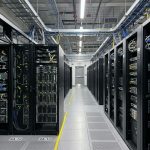
The conventional data center, optimized over two decades for cloud workloads at 10kW to 15kW per rack, is being torn up and rebuilt around AI. The driver is not abstract demand growth but a single, concrete fact: an Nvidia GB200 NVL72 rack draws roughly 132kW, weighs about 3,000 pounds, and cannot be air cooled at any practical scale. Every other design decision in an AI-era facility flows from that.
The density problem
The density numbers tell the story. Industry surveys put 2024 average rack density at around 12kW; CoreSite’s reporting cites Schneider Electric forecasts that next-generation Nvidia racks will hit 240kW within a year. Schneider itself estimates AI and large language model workloads will push rack densities to 60kW to 120kW in most new builds. The current Blackwell generation, per Supermicro’s GB200 NVL72 datasheet, packages 72 GPUs and 36 Grace CPUs into a single 600mm by 1,068mm by 2,236mm rack with operating power of 125kW to 135kW. Each B200 GPU inside it draws up to 1,200 watts. SemiAnalysis describes 40kW as roughly the ceiling for air-cooled H100 deployments; everything past it requires liquid.
That ceiling is a physics problem, not an engineering one. Liquid carries heat roughly 3,000 times more effectively than air per unit volume, according to Schneider’s data center practice. Air cooling tops out around 41kW per rack regardless of containment strategy, while direct-to-chip liquid cooling supports 100kW to 200kW comfortably and has, per industry surveys cited by Introl, already captured 47% of the liquid cooling market with about 22% of data centers actively deploying it. The Open Compute Project’s Open Systems for AI initiative has published a blueprint targeting racks drawing up to 1MW, a figure that would have been a small colocation suite a decade ago.
Cooling moves inside the rack
What this looks like on the floor is a wholesale rebuild of mechanical and electrical infrastructure. Nvidia’s contribution of the GB200 NVL72 design to OCP includes more than 100 pounds of steel reinforcement in the rack frame to handle 6,000 pounds of mating force across the tray stack, rear extensions to protect coolant manifold fittings, and a complete shift away from raised-floor air distribution. Coolant distribution units, either liquid-to-liquid or liquid-to-air, sit either in-rack or in-row. Schneider’s GB200 reference architecture and Vertiv’s competing 360AI design both target 132kW per rack with factory-integrated modules; Vertiv claims its MegaMod CoolChip can deliver turnkey AI infrastructure up to 50% faster than onsite builds. CoolIT’s CHx2000 CDU, cited in Nvidia’s Blackwell partner ecosystem, provides 2MW of cooling capacity at a 5°C approach temperature.
Hyperscalers standardize the new form factor
The major operators are using OCP as a forcing function. Meta’s Catalina, contributed to the foundation at the 2024 Global Summit, is built on the ORv3 high-power rack and supports up to 140kW per shelf, configured as a two-rack pod hosting the GB200 NVL72. Meta’s blog notes that its production GPU fleet went from roughly 6,000 chips in 2022 to over 100,000 in 2024, with another order of magnitude planned. Microsoft and Meta are jointly developing Mount Diablo, a disaggregated 400 VDC power rack that moves the rectification stage out of the IT rack itself, freeing space for more accelerators. Google has signaled separate interest in robotics for handling AI racks, on the not-unreasonable grounds that 3,000 pound enclosures are not friendly to human technicians.
Power becomes the binding constraint
The harder problem sits outside the building. Bloom Energy’s 2026 Data Center Power Report, summarized by Data Center Frontier, projects U.S. data center IT load growing from roughly 80GW in 2025 to about 150GW by 2028. ERCOT raised its 2030 data center demand forecast from 29GW to 77GW in a single planning cycle. The global development pipeline, by one count, hit 241GW at the end of 2025, up 159% in twelve months. In Northern Virginia, Texas, and parts of Ireland and the Nordics, interconnection timelines now run three to seven years. The capital is there (the four largest hyperscalers are projected to spend north of $400 billion in 2025), but transformers, transmission corridors, and generation capacity are not.
The industry’s response has been to route around the grid. Crusoe’s Abilene, Texas site for the Stargate joint venture, backed by OpenAI, Oracle, and SoftBank, includes on-site natural gas turbines capable of delivering close to 1GW, in part to avoid ERCOT’s interconnection queue. Google’s $4.75 billion December 2025 acquisition of developer Intersect Power, reported by PV Magazine, is a play to co-locate solar and storage on a private-wire basis with its data center campuses, bypassing public interconnection entirely. Wood Mackenzie’s Q3 2025 data tracked 245GW of planned U.S. solar and storage capacity, with 91% of clean power additions in the quarter going to solar plus batteries; the firm explicitly attributes the surge to data center demand. Texas’s Senate Bill 6, passed in 2025, now requires loads above 75MW to submit transmission screening studies with $100,000 fees and proof of site control, an attempt to filter speculative interconnection requests from real ones.
The carbon and water trade-offs
Behind-the-meter generation solves a near-term problem and creates two longer ones. The first is carbon: GlobalData expects gas and coal to supply more than 40% of data center electricity through 2030, regardless of how many power purchase agreements hyperscalers sign for renewables elsewhere. The second is water. Liquid cooling reduces facility-level PUE dramatically (operators report figures of 1.05 to 1.15 versus 1.4 to 1.8 for air), but it shifts the burden to water usage effectiveness. AIRSYS cites projections that liquid cooling could consume 1.7 trillion gallons of water annually by 2027, with individual hyperscale sites approaching 50 million gallons per year, much of it lost to evaporative cooling towers. Nvidia is marketing its Blackwell platform on a claimed 300-fold improvement in water efficiency relative to prior generations, though the comparison depends heavily on which baseline and which climate.
What this means for operators
The design implications are concrete. New AI-capable shells need 415V or higher distribution at the rack, slab construction rated for substantially higher point loads, plumbing for coolant supply at facility scale, and a power strategy that does not depend on a utility timeline. Retrofits of older cloud-era halls are possible but constrained, typically capped at the 60kW to 80kW per rack range without significant structural and electrical surgery. Colocation providers underwriting AI tenancy are increasingly being asked to sign leases that include private generation arrangements, water reuse commitments, and clauses that would have looked exotic two years ago.
What to watch
The first deployments of GB300 NVL72 are already in the field: CoreWeave announced general availability in August 2025, Azure followed in October, and AWS made its P6e-GB300 UltraServers generally available December 2, 2025. The racks beyond are where OCP’s 1MW target stops being aspirational. Whether the U.S. grid can deliver the additional 70GW that Bloom expects by 2028 will determine which of the 241GW in the global pipeline actually gets built, and where. The design playbook is being rewritten in real time, and most of the load it has to serve has not yet been ordered.